 1-216-595-0695 Sales


Mobile Inmate Tracking: Active or Passive RFID – Which is Right for You?
Introduction
One question we are often asked is, "what is the difference between active and passive RFID inmate tracking systems?" As used for inmate tracking, the primary difference between active and passive RFID lies in how the tags communicate and their resulting capabilities.
Active RFID Mobile Tracking Systems

Power Source and Range
Active RFID tags have their own battery, which allows them to transmit signals continuously or at specified intervals. These tags have a longer range, typically between 100 to 300 feet, depending on the environment.
Functionality and Use Case
Active RFID systems provide more detailed tracking, allowing for real-time location updates. These systems can trigger alerts for out-of-bounds or keep-separate events. Guard1 Real Time systems also support officer duress devices or staff personal alarms. Active RFID is used in situations where continuous, real-time monitoring is required, to reduce officer tasks and increase a facility's efficiency.
Cost Considerations
Active RFID inmate tracking costs more and depends on system design, facility construction and other factors.
Passive RFID Mobile Tracking Systems
Power Source and Range
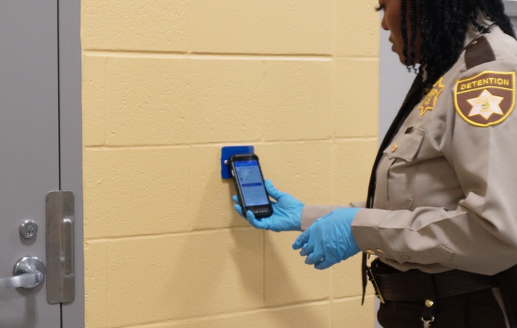
Passive RFID tags do not have a battery. Instead, they rely on RFID readers like the Guard1 SuperMAX to activate the tag and transmit information. These tags have a much shorter range, usually between 1 to 10 centimeters, which means they are only activated when they come into close proximity to a reader.
Functionality and Use Case
Passive RFID is used mainly for logging and verifying staff actions, such as confirming that a cell check has been completed or monitoring the issuance of items like linens or commissary goods. It doesn't provide continuous tracking or real-time updates. Passive RFID is typically used for less frequent monitoring tasks, where only specific actions or locations need to be logged.
Cost Considerations
Passive RFID inmate tracking typically costs somewhat less than active RFID.
Software Differences and Mobile Capabilities
The software differences between active and passive RFID systems arise from their functionality, real-time capabilities, and complexity.
Active RFID Software
Active RFID systems are designed for continuous, real-time data processing. These systems manage large volumes of data, providing real-time tracking of inmate movements and triggering alerts if an inmate enters restricted zones or exhibits unusual behavior.
The software supports advanced data analysis to help facility managers optimize security and operational efficiency. Active RFID systems can trigger notifications instantly, enabling rapid responses to security threats. These systems also require a more sophisticated user interface and robust architecture to handle large-scale installations.
Passive RFID Software
Making Your Choice
Active RFID is more suited for real-time, long-range tracking and constant monitoring, while passive RFID is used for localized, event-based logging within a correctional facility. Both systems have their advantages, depending on the specific needs of the facility.
Active RFID inmate tracking software is suited for environments that need continuous tracking, real time alerts, and comprehensive analytics, while passive RFID software is ideal for less demanding event logging and compliance tracking.
Choosing an RFID inmate tracking system that supports both technologies – like Guard1 Real Time – means you are getting the most advanced and most capable technology, with the ability to use both technologies or upgrade as your facility and your needs grow.